



Delayed major-suit raises at the three-level, forcing or non-forcing?

THIS ARTICLE IS OFFERED TO YOU
We are pleased to offer you this exclusive BRIDGERAMA+ post.
North-South have reached a very poor contract. As so often, each of the two players considers that his partner is responsible for the accident. And you, what do you think?
This month we will look at:
Delayed major-suit raises at the three-level, forcing or non-forcing?
Problem 1

| W | N | E | S |
|---|---|---|---|
| 1♥ | Pass | 1♠ | |
| Pass | 2♥ | Pass | 3♥ |
| Pass | 4♥ |
The facts
Game was reached by chance, the slam never really considered.
Arguments
North: “Do you realize I could have passed 3♥? Because in my opinion your bid is non-forcing. That being said, you may be right, otherwise I don’t see how to naturally show a forcing raise.”
South: “You have to learn the basic rules. Delayed raises shown at the three-level are forcing and therefore stronger than a jump to game. I have no other way to investigate slam. When your 4♥ bid tells me that you have a minimum opening, not even good enough for a 3NT “YES, BUT”, I can only pass.”
Verdict
A frequent mix-up concerning the forcing or non-forcing character of the 3♥ bid in this bidding sequence. The 2♥ rebid has a special meaning after the 1♠ response. It guarantees six cards in Hearts, which is not the case opposite a 2♣ or 2♦ response. This means that if responder has two Hearts, an eight-card fit is found and must be shown. This is why 3♥, non-forcing, shows between 9 and 11-H (the equivalent of a 2NT response with 11H and three trumps), for example: ♠A654 ♥K3 ♦K9842 ♣92. We bid 4♥ with hands between 11+and 13HCP. It remains to solve the problem of a forcing raise in Hearts. There are three possible solutions:
- The standard solution, showing values in a third suit (3♣ or 3♦), and then showing the Heart fit in a forcing situation as best you can.
- A less classic solution, but one that clearly shows support without meandering, is to jump to the four-level, 4♣ or 4♦ as an anticipatory cue-bid, showing either shortness or a control by an honor.
- A recent technical solution. Use bidding 2NT over 2♥ as forcing raise. This is not for everyone.
The bid responsible for the accident
3♥ over 2♥, a non-forcing bid. South is 100% responsible.
The correct standard auction:
| W | N | E | S |
|---|---|---|---|
| 1♥ | Pass | 1♠ | |
| Pass | 2♥ | Pass | 3♦ |
| Pass | 3NT | Pass | 4♥ |
| Pass | 4NT | Pass | 5♥ |
| Pass | 6♥ |
Problem 2
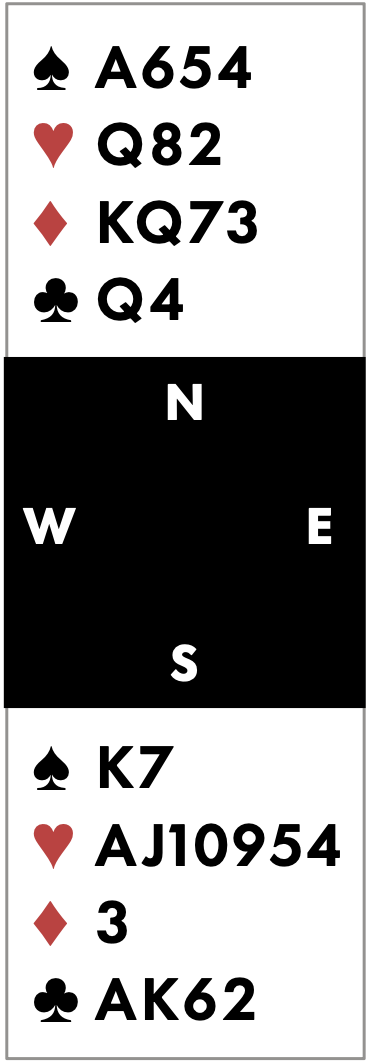
| W | N | E | S |
|---|---|---|---|
| 1♦ | Pass | 1♥ | |
| Pass | 1♠ | Pass | 2♣ |
| Pass | 2♥ | Pass | 3♥ |
The facts
The slam depends on a finesse and should not be bid, but it would be laydown with the Diamond Ace instead of King-Queen.
Arguments
North: “Why are you setting traps for me? I understand nothing of your rules of I don’t know who after fourth suit forcing, all I know is that, intuitively, your bids don’t seem forcing to me. If you want to play a slam, it is not difficult to bid RKCB, you have controls in all the suits, all you need is the number of keycards.”
South: “It is Lévy’s rule and I’ve told you a hundred times. I think at least you won’t forget this sequence again.”
Verdict
The two auctions we have looked at resemble each other. This time, it is fourth suit forcing that is responsible for the accident. I must admit, though, that intuitively this sequence indeed seems non-forcing… How can you safely distinguish between forcing and non-forcing bids by responder after fourth suit forcing? Here is a rule that is simple to remember that will help you make no more mistakes:
After fourth suit forcing, responder’s third bid is non-forcing if it is made at the two-level and game forcing if it is made at the three-level.
If he had known Lévy’s rule, North would not have passed…
A comment concerning North’s question, in which he criticizes his partner for not bidding RKCB directly after 2♥. 4NT would not be RKCB, with the eight-card fit not yet explicitly known, it is a quantitative bid.
And finally, once the forcing nature of the 3♥ bid has been accepted, it is easy to understand that this bid shows a better hand than 4♥. Furthermore, over 3♥, 4♥ from North is a legitimate jump on the brakes, but this should not prevent South from asking for keycards.
The bid responsible for the accident
Pass over 3♥. North is 100% responsible.
The correct auction:
| W | N | E | S |
|---|---|---|---|
| 1♦ | Pass | 1♥ | |
| Pass | 1♠ | Pass | 2♣ |
| Pass | 2♥ | Pass | 3♥ |
| Pass | 4♥ | Pass | 4NT |
| Pass | 5♦ | Pass | 5♥ |
Problem 3
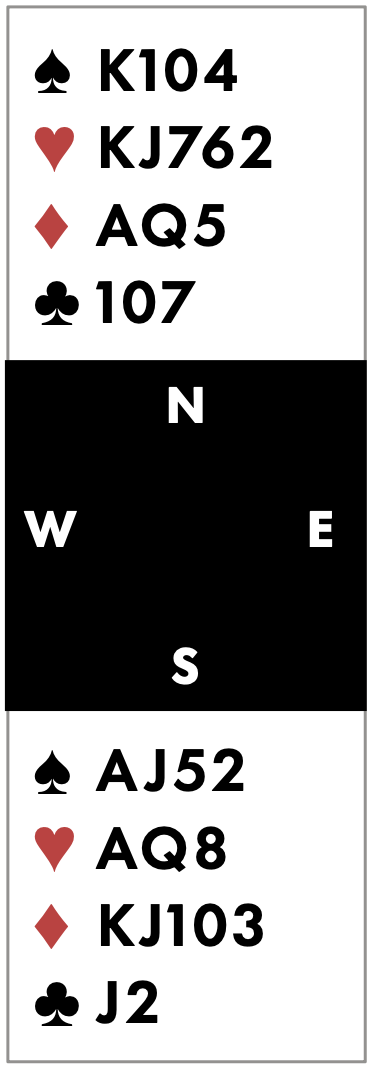
| W | N | E | S |
|---|---|---|---|
| 1♥ | Pass | 1♠ | |
| 2♣ | Pass | Pass | 3♥ |
The facts
Another laydown game level contract missed!
Arguments
North: “We’ve talked several times about this case of forcing or non-forcing bids after an overcall. No natural bid is forcing – with or without a jump. Thanks to the overcall we have two calls at our disposal to initiate a forcing process, Double and a cue-bid.”
South: “I remember that discussion very well, but I don’t think we addressed the case of delayed jump raises. Within our system, I can’t see with which kind of limit hand with Heart support I should respond 1♠ to 1♥, rather than immediately show my fit by way of 3♥ or 2NT.”
Verdict
Decidedly, this 3♥ bid poses many problems for our candidates who, in these three deals, were never on the same wavelength as to whether it is forcing or not. It is necessary to admit that a simple overcall can modify the meaning of a bid that can become competitive, even when we are talking about a jump. And this is the argument put forward by North when he passed 3♥, an argument contradicted by South who asserts that the principles developed by his partner on reopening bids do not apply to bids that show support.
Let’s take a closer look, starting with a similar but not identical bidding sequence.
| W | N | E | S |
|---|---|---|---|
| 1♦ | Pass | 1♥ | |
| 1♠ | Pass | Pass | 3♣(♦) |
The question to ask is still the same. If 3♣ and 3♦ are forcing bids, how do you show a limit hand with a two-suiter with Hearts and Clubs or with Diamond support? And conversely, how do you show a forcing raise in Diamonds, or a game-forcing two-suiter if 3♣ and 3♦ are limit bids? And the answer was very correctly given by North. To initiate a forcing process after an overcall by player n°4 and pass-pass, responder must reopen either with a Double or a cue-bid. To simplify, the Double looks for three-card support in the major, the cue-bid looks for a stopper to play in No-Trump or prepares a forcing raise in opener’s minor.
As a corollary, natural reopenings, here 3♣ and 3♦ are non-forcing.
Let’s ask ourselves the same question for the auction of our third example. And this time, it’s South who gives the decisive argument. With a limit hand, support must always be shown directly in response to the opening bid, 1♠ denying therefore a limit raise. You know very well that you must respond 3♥ over 1♥ and bypass Spades with ♠KQ962 ♥Q1083 ♦J2 ♣73 and that you must answer 2NT over 1♥ and bypass Spades with ♠A10754 ♥K97 ♦87 ♣K52. A balancing 3♥ can show neither of these two hands. It follows that South has responded 1♠ with a hand that is too strong for a direct raise in Hearts and 3♥ is very well game forcing.
The bid responsible for the accident
Pass over 3♥. North passed a forcing bid, he is 100% responsible.
The correct auction:
| W | N | E | S |
|---|---|---|---|
| 1♥ | Pass | 1♠ | |
| 2♣ | Pass | Pass | 3♥ |
| Pass | 4♥ |
