



DO YOU KNOW THE SCRAMBLING 2NT?

THIS ARTICLE IS OFFERED TO YOU
We are pleased to offer you this exclusive BRIDGERAMA+ post.
In this new column, our two authors join forces to present a new tactical principle every month, rarely highlighted in classic texts.
Today, let’s take a look at the Scrambling 2NT, an excellent convention invented in the USA.
First, let’s look at the context in which it is used. The auction starts as follows:
| W | N | E | S |
|---|---|---|---|
| YOU | |||
| 1♥ | Pass | 2♥ | Pass |
| Pass | ? |
Your partner and then you have both passed at your first turn. If North passes again, that will be it. However, your side has roughly as many points as the other, and that is independent of the number of points in the hand of the player in the pass-out position ‒ North, in this case.
In such a context where the opponents have a fit but limited strength, the question to ask yourself should not be, “Should I or should I not reopen the bidding?” but rather, “How should I reopen?”
This is why, especially in pairs tournaments, strength counted in HCP is not a criterion for deciding whether or not to “fight for the part-score“, not to mention the fact that seeing your opponents bid one level higher will always constitute a “small” victory.
Among the calls that are available in such a situation, the take-out Double is frequently used and, given the inherent vagueness that comes with its almost automatic use, the Scrambling 2NT is an extremely useful tool for retrieving information.
Deal A
Dealer West, None Vul. Let’s go back to the auction:
| W | N | E | S |
|---|---|---|---|
| YOU | |||
| 1♥ | Pass | 2♥ | Pass |
| Pass | ? |
North holds ♠AQ65 ♥84 ♦KJ83 ♣976. Holding a doubleton Heart, he has no difficulty making a re-opening take-out Double. What will you say as South with ♠73 ♥652 ♦AQ107 ♣Q1083? Lacking a four-card Spade suit but looking at two four-card minors, this is precisely where the Scrambling 2NT comes in useful as it invites the player who doubled to bid his suits in ascending order and thus allows the pair to find the eight-card Diamond fit, which would not be the case had you responded 3♣ to the Double. With his hand, North will say 3♦ over 2NT and you will pass:
| W | N | E | S |
|---|---|---|---|
| YOU | |||
| 1♥ | Pass | 2♥ | Pass |
| Pass | Dble | Pass | 2NT |
| Pass | 3♦ |
Here is the full deal:
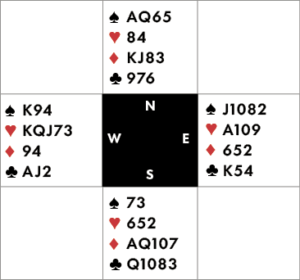
3 Diamonds is one down (you lose two Hearts and three Clubs), which will be profitable since even against the best defense (two rounds of Diamonds followed by a Spade switch from your side), 2 Hearts makes. Let’s swap the Jack of Clubs between West and East. True, now 2 Hearts will go down but then your side makes 3 Diamonds.
Deal B
Dealer West, None Vul.
This time, you see all 52 cards:
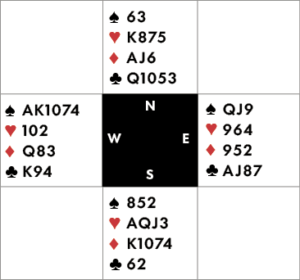
And you are invited to imagine the auction the way it should unfold:
| W | N | E | S |
|---|---|---|---|
| YOU | |||
| 1♠ | Pass | 2♠ | Pass |
| Pass | Dble | Pass | 2NT |
| Pass | 3♣ | Pass | 3♦ |
| Pass | 3♥ |
South uses the Scrambling 2NT because he has two suits. Over 3♣, he then bids 3♦, indicating Diamonds and Hearts, and North corrects. At the helm in 3 Hearts, North meticulously counts his opponents’ points and easily finds the Queen of Diamonds in opener’s hand for just made.
Perhaps some of you will think that it would have been smarter to bid 3♥ directly over North’s Double to end up with the best contract? This is not true, however when North holds three Hearts and four Diamonds, it is much better to play 3 Diamonds rather than 3 Hearts, don’t you think?
The Scrambling 2NT is an indispensable convention, allowing you to discover the best fit after a second-round take out Double.
